
S h a r e
Flying cars? Let’s keep our feet on the ground

Posted by
Charlie Strand
November 2026
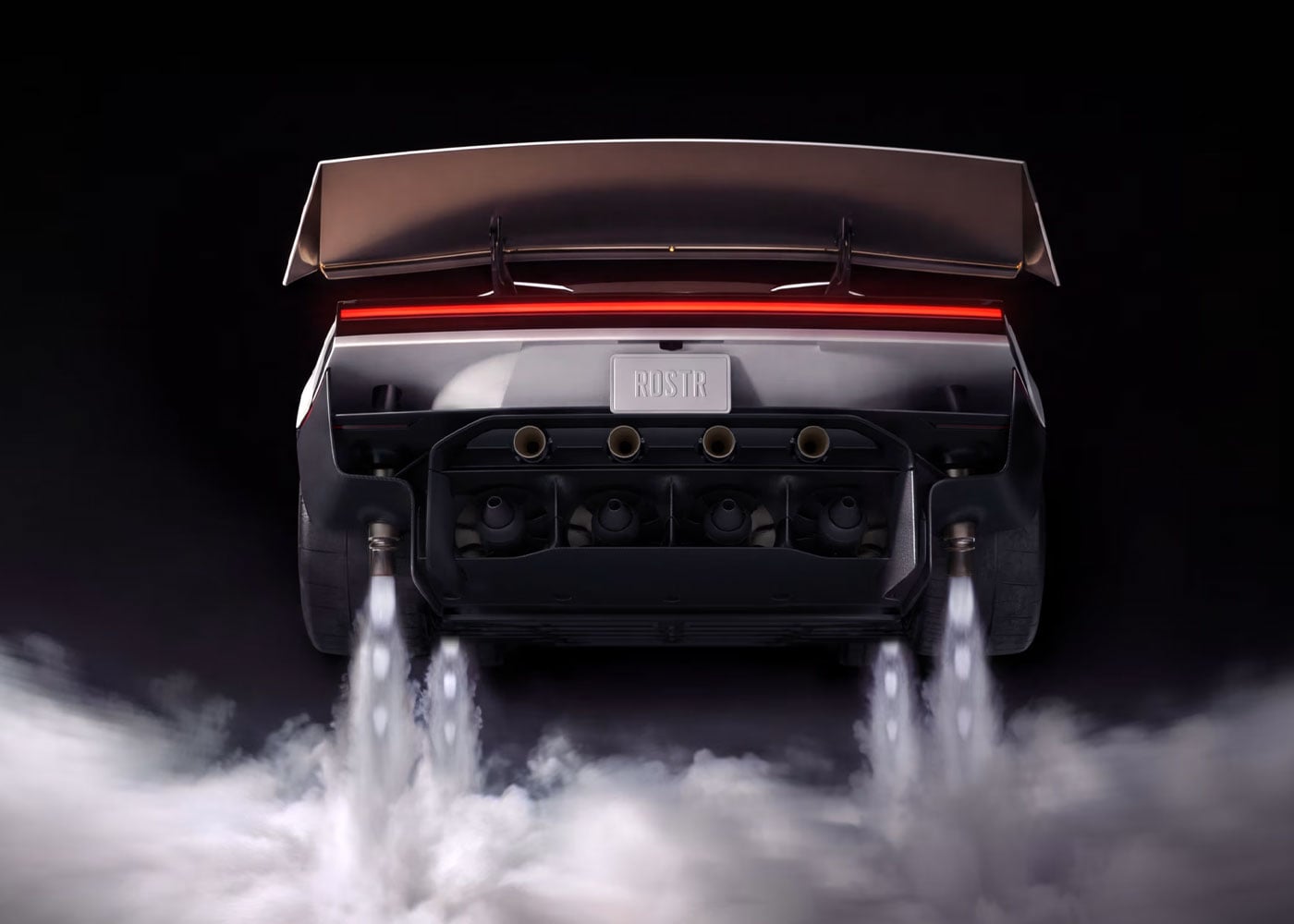
McMurtry, with its Speirling track car (check it out here speeding up the Goodwood hill) may have been first with a vehicle that could suck itself to the ceiling without needing to be moving, but adding thrusters that allows a car to fly, albeit briefly, means the Tesla Roadster takes things to another level.
It may be called Roadster, but by the dictionary definition, it isn’t a proper roadster: there’s no folding soft-top, just a couple of removable panels.
What we can say with certainty is that it’s an electric car, so there are no exhaust emissions. However…it also has rockets. These compressed-air thrusters will allow it to ‘fly’ for a short time. Let’s hope the authorities don’t decide that thrust counts as emissions and try to tax it accordingly.
Demonstrated at Elon Musk’s Space X facility, the Roadster took off, flipped 360 degrees, then landed safely again on its four wheels.
You’re also going to want to be very well strapped in if you’re planning to go inverted. And who really needs to accelerate from 0-60mph in less than a second? A Porsche Taycan Turbo S is capable of 0-60mph in 2.3 seconds, and if you do that it’s not an entirely pleasant experience. Neck brace? You may need one…
But, beyond the spectacle, what does the Tesla Roadster tell us about the future of mobility?
Flying cars have long been held up as the next big thing. They exist, in various forms (the PAL-V Liberty for example), but are unlikely to become commonplace on our roads any time soon.
Engineering is only part of the challenge. Safety, infrastructure and regulation are huge obstacles, particularly when legislators are still grappling with the implications of autonomous cars. If a car goes airborne, surely that makes it an aircraft and the driver a pilot. Is the Civil Aviation Authority ready for this?
So, let’s assume the Roadster won’t fly, at least not in the production version expected in 2028. Some of its technology, however, could prove more significant. The demonstration was conducted autonomously, with Elon Musk explaining that this was to make sure they didn’t kill anyone. It was a reminder that, for all the theatrics, automation is where the more meaningful advances in mobility are likely to emerge.
For fleet operators, the potential benefits are considerably more practical than flying. Better driver-assistance systems and, eventually, autonomous vehicles could improve safety, reduce collisions and change how businesses manage vehicle utilisation. Not to mention the benefits to cleaner air.
There are opportunities beyond driving, too. Modern vehicles can monitor their own health, yet drivers still routinely ignore dashboard warning lights. Better connectivity and predictive diagnostics could alert fleet managers to developing faults, arrange maintenance before a breakdown and reduce vehicle downtime. The result could be more predictable SMR costs and reduced downtime.
And just as we’re getting used to electric vehicles, should we expect another propulsion revolution? Hydrogen, synthetic fuels and other alternatives may have a role to play in applications where battery-electric vehicles are less practical. For now, though, the priority is matching the technology to the job.
The Roadster is unlikely to be the answer to the future of mobility.
But the world needs people prepared to push engineering boundaries. The value of doing so isn’t always the finished product; sometimes it is the questions raised and the conversations that start as a result.
For fleet operators, the most important question isn’t whether their cars will fly, but whether tomorrow’s technology will make their businesses safer, cleaner and more efficient.
You also might like…
If you liked this article then check out our posts about similar topics
Government confirms adoption of Euro 7 emissions
The UK Government has confirmed it will adopt Euro 7 emissions standards for new cars and vans registered in Great Brita...
Budget 2026: The key points and impact for fleets and drivers
Chancellor John Healey has delivered his first Budget We look at what it means for fleets and drivers, including company...
Fleet Alliance celebrates 15 Years as a Great Place To Work®
I'm delighted to share that Fleet Alliance has once again been certified as a Great Place To Work®, marking the 15th ye...
Is your fleet provider doing enough for your business?
Your fleet provider’s value becomes clear in the work they take off your team and the decisions they help you make A c...
Changan Deepal S05 First Drive: A New Name to Take Seriously
Hot on the heels of September’s SMMT figures showing Chinese manufacturers taking a growing share of UK new car regist...
The exponential growth of salary sacrifice
The UK new electric car market just grows and grows, thanks in no small part to the rocketing popularity of salary sacri...
Coping with the high cost of diesel
The pressure on transportation costs is enormous at the moment The US-Iran conflict shows no signs of easing and the p...
Outsourcing Car Fleet Management
Managing a company fleet takes time, specialist knowledge and careful cost control From sourcing vehicles and managing r...
Ready to make the management of your fleet more efficient?
Request a call back