S h a r e
Choosing an EV – when you drive lots of miles for your job

Posted by
The EV Team
January 2026
Electric cars and high mileages might not seem an ideal match.
Drivers regularly covering long trips, particularly along the UK’s motorway network, have traditionally steered away from pure-electric models. But that’s no longer the case.
Battery technology has improved substantially with every new entrant. Model by model. Year by year.
In 2025, the average range of an EV, according to the Society of Motor Manufacturers & Traders, was almost 300 miles. But some new cars are now capable of more than 480 miles on a single charge (see our table below).
Of course suitability depends on journey type, not just journey length, and how those trips are broken down.
For example, if you cover a really high mileage, say 42,000 miles a year (that’s 1,000 business miles a week) then even this would easily suit electric car use with 250-300+ miles a day, allowing for three-to-four days travel and one or two working from home. With those who can’t home charge excepted, of course.
A driving schedule split this way would easily suit an electric car, with many EVs capable of covering more than 250 real-world miles on a single charge. We’ve listed the current top 10 models with the most range (all in excess of 400 miles), according to official WLTP figures:
Top 10 EVs with the longest range
| Rank | Vehicle | Range (miles) |
|---|---|---|
| 1 | BMW iX3 50 xDrive M Sport | 500 |
| 2 | Mercedes-Benz EQS?450+ AMG Line Premium | 485 |
| 3 | Mercedes-Benz CLA?250+ with EQ technology | 483 |
| 4 | Audi A6 Sportback e-tron Performance | 472 |
| 5 | DS No. 8 FWD Long Range | 466 |
| 6 | Tesla Model 3 Rear-Wheel Drive Long Range | 466 |
| 7 | Volkswagen ID.7 Match Pro S Match Plus | 433 |
| 8 | Polestar 3 Long range Single motor | 433 |
| 9 | Mercedes-Benz EQE?350+ AMG Line Edition + Refinement package | 429 |
| 10 | Peugeot E-3008 Long Range 230 Allure | 435 |
What if the range is not enough?
There’s no doubt that driving an EV requires some more planning, especially if you know that your journey will be greater than the range available on the EV’s battery. So it’s sensible to work out in advance where it might be convenient to stop and add additional charge to the battery.
Beyond that, though, it’s best practice in any car to stop after two hours at the wheel, otherwise safety-compromising fatigue can set in. And a quick break is a perfect opportunity to recharge both you and your vehicle’s battery.
You can plan a journey break that can include a charge up of your car’s battery by using your car’s onboard navigation system, which can direct you to suitable charging stopovers on your journey, or by using am EV charge mapping resource such as Zap-Map,
Rapid and ultra-rapid chargers can top up the battery very quickly. A 20-minute charge can give you up to 80% capacity, which is about the time needed to take a break, grab a coffee and walk back to your car.
Charging is already available at 97% of motorway service areas, with more than 800 rapid or ultra-rapid chargers in these locations, according to the Office for Zero Emission Vehicles (OZEV) guidance in April 2025.
More recently Zapmap has reported that there are nearly 18,000 rapid or ultra-rapid chargers available, a 24% uplift year-on-year.
These services are being complemented by EV charging hubs close to main routes, which boast large numbers of high power chargers.
What about charging at home?
We would advise all higher mileage drivers to have access to a home charger – it can still work without one, but if your job is to drive the miles, you really will need a home charger to make EV-life efficient, so that when you get home at the end of the day, the car can be plugged in and ready for you the next morning. (See our section Ordering a home charger.)
How long will it take to charge my car overnight?
A standard 7kW home charger will charge 3x faster than a domestic three-pin socket, which is not suitable for regular recharging anyway.
For a broad idea of how quickly your battery will be charged, you divide the usable capacity of your battery by the output of your charger. We’ve taken the EVs from our list above to provide you with a guide to how quickly they will take to charge overnight from zero to 100% and the cost (calculated at 26.35p per kWh, the UK Price Cap electricity unit cost).
There are two things to note: Firstly, these are maximum times – from 0-100% – but very rarely will a driver get to single figures in battery percent before charging, and many charge from around 20%, so charging times will usually be a lot shorter. It’s also worth knowing that there are off-peak EV-tailored home energy tariffs available, which can bring pence per unit prices to as low as 6.5p/kWh, which could considerably reduce charging costs.
Average charging costs on a home charger
| Vehicle | Range | Battery | Time (hrs) | Cost |
|---|---|---|---|---|
| BMW iX3 50 xDrive M Sport | 500 | 108.7kWh | 15. 5 | £29 |
| Mercedes-Benz EQS?450+ AMG Line Premium | 485 | 118kWh | 16.9 | £31 |
| Mercedes-Benz CLA?250+ with EQ technology | 483 | 85kWh | 12.1 | £22 |
| Audi A6 Sportback e-tron Performance | 472 | 94.9kWh | 13.6 | £25 |
| DS No.8 FWD Long Range | 466 | 97.2kWh | 13.9 | £26 |
| Tesla Model 3 Rear-Wheel Drive Long Range | 466 | 78.1kWh | 11.2 | £21 |
| Volkswagen ID.7 Match Pro S Match Plus | 433 | 86kWh | 12.3 | £23 |
| Polestar 3 Long range Single motor | 433 | 107kWh | 15.3 | £28 |
| Mercedes-Benz EQE?350+ AMG Line Edition | 429 | 96kWh | 13.7 | £25 |
| Peugeot E-3008 Long Range 230 Allure | 435 | 97kWh | 13.9 | £26 |
| Peugeot E-3008 Long Range 230 Allure | 435 | 97kWh | 13.9 | £26 |
Figures based on top 10 EVs with the longest range and an average energy cost of 26.35p per kWh.
Make the most of your charge
The majority of EVs have an app linked to the car that allows you to perform functions while the vehicle is still connected to the charger. The most obvious one is heating the car and defrosting it during winter. The car will do this while still drawing electricity from the mains rather than once you have started and you drain the battery, depleting range. And you get to step into a nice warm car that’s ready to drive away.
Some cars also have the ability to pre-condition the battery. This effectively takes the battery to its optimal operating temperature before you drive, which helps extend the vehicle’s range. Plotting in charging stops in certain EVs will see the same pre-conditioning process start while driving as you get close to the charger, reducing waiting times with the fastest possible charge.
However, you should also be aware that the amount of available range can vary between summer and winter driving conditions by between 10-20% as the cold effects battery efficiency. So, if your EV has a range of 380 miles, it can drop down to 304 miles in very cold conditions and will need to be factored into driving routes and potential charging stops.
BIK advantages
The benefits of an EV for longer distance drivers are the same as they are for drivers that cover fewer miles. But the savings have the potential to be far greater.
If diesels are the high mileage choice, the difference in taxation between a diesel and an EV is extraordinary. The Benefit-in-Kind (BIK) rate for the 2025/26 tax year is just 3% for an EV while a high-emitting diesel vehicle could be as high as 37%. In monetary terms the BIK saving could be more than £6,200 per year for a 40% taxpayer comparing a diesel SUV to a battery electric SUV. So, the tax savings alone for choosing an EV are worthwhile.
This is why it makes sense to understand your journey needs and understand how to make an EV work for your business requirements. For today’s long-distance business drivers, choosing a suitable EV really is easier than ever before.
High mileage driver – Rob Wentworth-James
Genesis GV60 ESTATE 360kW Sport Plus
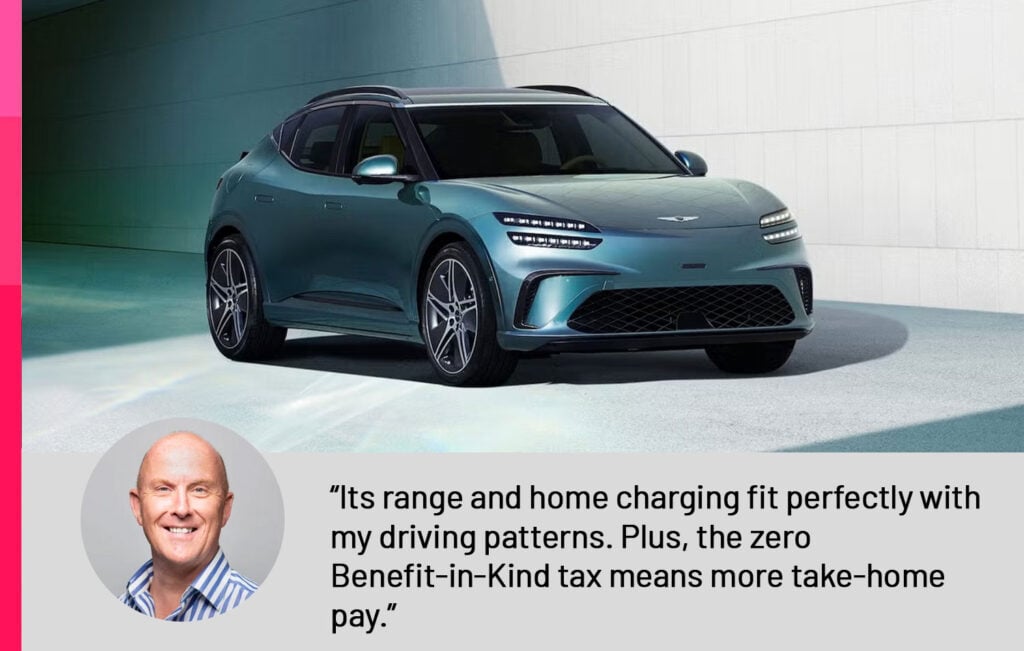
Rob Wentworth-James, Business Development Director at Fleet Alliance, drives around 20,000 miles a year, 13,000 of which are for business.
“Not so long ago, high-mileage drivers like me would automatically go for a diesel,” he says. “But with improved EV ranges and charging networks, that’s no longer the case.”
Rob now drives a Genesis GV60. “Its range and rapid charging fit perfectly with my driving patterns. Plus, the low Benefit-in-Kind tax – just 4% in the 2026/27 financial year – means more take-home pay.”
On public charging, he adds: “Rapid chargers on motorways make longer trips simple. A 16–20-minute top-up is all it takes thanks to the cars 800v architecture and I’ve never had to wait—it’s a seamless experience.”
His advice for other high-mileage drivers: “Driving electric isn’t much different from petrol or diesel—you just plan a little more. For trips over 250 miles, the train can be more productive, but otherwise an EV works brilliantly. There’s no reason high-mileage drivers shouldn’t go electric.”