S h a r e
Changing a business fleet to electric


Posted by
The EV Team
January 2026
It’s a significant decision to take your company car fleet electric. But one that requires serious consideration.
By 2030 the UK Government is banning the sale of new petrol and diesel cars – in effect that’s just over one typical fleet replacement cycle away – while new full hybrid and plug-in hybrid electric vehicles (PHEV) will be off sale by 2035.
So there’s a compelling urgency to consider taking your fleet electric as soon as is practical.
The good news is that the benefits to your business, your fleet drivers, and the environment – including local air quality – are enormous. So, where do you start?
Establish the framework for your fleet
You need to commence by framing the argument for moving to electric vehicles (EVs). You can do this by yourself, or request the assistance of a fleet management company to help you through the process.
Start by establishing the reasons behind the move to fleet electrification. Aside from the trajectory set by the Government, switching to electric may help meet Environmental, Social and Governance (ESG) objectives, and bring cost savings.
The cost reductions on the car fleet could include reduced fuel costs (even if a new pay-per-mile tax for EVs and PHEVs – the electric vehicle excise duty or eVED – is introduced from April 2028). A further benefit is lower maintenance bills as EVs have fewer moving parts.
If you operate in London your cars will qualify for a 100% discount for the congestion charge until 2 January 2026. If you register for TfL’s Auto Pay service you’ll then get a 25% discount until 4 March 2030 when it drops to 12.5% discount.
Aside from saving on the congestion charge, your electric vehicles will also be compliant with the London ultra low emission zone (ULEZ), clean air zones (CAZs) in England and low emission zones (LEZs) in Scotland.
It’s also important to point out to your fleet drivers the financial benefits of switching to electric in the form of exceptionally low benefit in kind taxation. From the 2026/27 tax year, the benefit in kind rate for zero emission EVs is just 4%. It then rises in 1% steps each financial year until 2029/30 when it will still be 9%.
For the business itself, there’s also reduced Class 1a National Insurance payments on the lower benefit in kind, which over a large fleet can be significant for the bottom line.
Aside from the financial benefits, consider how much lower your fleet’s CO2 emissions will be, since EVs have zero tailpipe emissions. This will help as part of your ESG decarbonisation programme – and it can include wider benefits across the business if a salary sacrifice scheme is included for those employees who are not eligible for a company car.
Finally, it’s important to communicate clearly to your employees why you are taking the decision to electrify your fleet and the benefits it will bring both to individuals and to the business as part of its ESG agenda.
Reviewing the fleet for electrification
The next item on the to-do list is a fleet review. Assess the suitability of your company car drivers to make a successful transition to an electric car. What is their typical business mileage and commute? Could this be performed comfortably in an EV? Could charging facilities be established where they live? If not, what – if any – is the fallback (see our guide: Choosing an EV – when you live in a flat).
For those drivers for whom an EV is not currently suitable, would a PHEV work as an interim measure? Many PHEVs now have extensive zero mileage capability but have the back up of a combustion engine for those drivers in more remote locations. However, you should discuss the benefit in kind implications with them, because the rates for PHEVs increase rapidly over the next two years.
You will also need to review your fleet structure and how employee entitlements will alter, particularly if your fleet grades are based around rental bands. Again, this is where a fleet management company can assist you with a move to a Whole Life Cost value over the leasing period. The Whole Life Cost considers all the cost factors involved in the lease lifecycle of a fleet car, rather than just the base rental cost. This is the only true way to compare different cars ‘on a level playing field’ basis.
Consider EV charger installation
There are two areas you need to consider here. The first is supporting staff with the installation of an EV charger at home.
The Government provides home charger installation grants for those that live in flats or rented properties and have off-street parking, and for households that only have on-street parking for the installation of pavement gulleys.
It may well be useful to bundle up the cost of the charger in the rental to make the switch to electric as easy as possible for staff.
The second area is the provision of EV chargers at work.
It will certainly encourage staff to use their EVs and PHEVs and is a visual reminder of your company’s change of fleet policy.
The Government offers grant vouchers for businesses. This is called the Workplace Charging Scheme. Eligible businesses can claim up to 75% of the purchase and installation costs, up to a maximum of £350 for each socket. The scheme supports the installation of up to 40 sockets. Funding is available until 31 March 2026.
However, it’s important that you contact your local Distribution Network Operator (DNO) to complete a site survey so you can determine what electricity supply is required and the amount of available capacity at the site. If there isn’t enough capacity and an upgrade is required the costs should largely be paid for by the DNO thanks to rules introduced by regulator Ofgem in April 2023.
Small and medium-sized businesses can also apply for the EV infrastructure grant for up to £15,000 off the cost of wider building and installation work required to install multiple chargepoint sockets. Eligible businesses can receive up to five grants across five different sites. Funding is confirmed until 31 March 2026.
Further assistance for businesses located in Scotland may be available from the Energy Saving Trust, which works with Transport Scotland to promote the uptake of EVs.
You can also decide, if you wish, to allow drivers to charge for free, or recoup some of the installation costs with a charging fee. Nevertheless, this should be balanced against the overall cost savings the fleet expects to make against previous fuel spend.
Fleet Alliance has a dedicated service called Fleet Zero that can assist fleets by matching EVs to the right charging solutions – whether that’s home for company car drivers, workplace chargers, or even charging facilities made available to the public.
Continuous communication of fleet policy
As we noted at the beginning, at every stage of the process to electrify your fleet, it’s important to keep your staff informed of the changes you are preparing to make. For many employees, there is often a fear of change, and with EVs a sense of taking a step into the unknown, particularly with new technology.
So communicating regularly with staff and outlining your plans and the benefits of EVs is critical to ensure a smooth transition, while also updating them with an understanding of how EVs work, how to charge them and so on.
Implementing fleet change
Moving your fleet over to EVs is best completed as existing leases come up for renewal. This allows you to deal with small batches of drivers at a time. It’s certainly worth considering having an initial test group so you can iron out any issues as the EV rollout accelerates and implement learnings from the test group across the wider EV roll out.
We would also suggest you continue to tell staff what is happening – and provide feedback from users who have made the change – to get real traction from staff on the EV changeover. Positive feedback will help encourage staff on the journey to electrification.
Some PR support might be worth considering to explain to stakeholders and the wider public what you are doing and why – it should make a positive news story for your business.
Review and implement alterations
It’s crucial to review with staff that have changed over to EVs after a period of three months. This will give them time to get used to driving EVs and EV charging and also unearth any issues which you can then address.
Any concerns or difficulties can then be fed back into your new fleet policy and any necessary changes or alterations made.
What’s it like to implement business change?
Executive Chair of Fleet Alliance, Martin Brown, explains how the company decided to move its company car fleet fully electric back in 2018.
“If you want to lead in a sector, there’s only one thing to do – and that’s by example. From the front,” explains Martin.
Fleet Alliance began switching its own company fleet to fully electric in 2018 as existing leases expired and completed the process in 2021. Many drivers are now on their second or third electric company car.
“I believed it was crucial for a fleet management company to show leadership in the sector,” says Martin. “We think that our customers should be moving to an electrified fleet, and it was important for us to demonstrate our belief in that conviction by moving first.
“So that’s the crucial thing – showing sector leadership. But of course, there are plenty of other benefits such as fleet decarbonisation, cleaner urban air and significant advantages to benefit-in-kind.”
Martin says staff did not resist the idea, but there was a certain amount of employee anxiety as the company started its electrification journey.
“I think our staff embraced the idea because there was something of a novelty factor, especially for a fleet management company leading the way when peers were still reticent, while the changes to benefit in kind also played a part. But there were a few mental barriers. I think the major issue was the change of mindset. By that, I mean the switch from not really having to think about your journey to one of active travel management such as planning for a charging break. A certain amount of education was required on our part for the mental reset.”
First steps
Wanting to move your fleet over to electric is one thing, but actually taking the necessary steps is quite another. So how did Fleet Alliance start?
“It is crucial to make the cars available on your fleet,” Martin explains. “When we started our programme, there was a restricted fully electric choice list. Since then it has become easier as a far wider choice of vehicles is now available, but choices at the lower end of the car choice bandings were difficult at the beginning because of the lack of available vehicles.
“So, in many respects, it was easier to start top-down because the cars in that pay scale range worked well – particularly the Tesla Model 3. This was a car that executives wanted, it had the range and the BIK worked. So getting the cars on the choice list is the number one action.”
While Martin says the business does not expect to make significant savings – simply because the higher rental of EVs balances out the NIC savings – employees certainly enjoy a significant boost to take-home pay thanks to the BIK advantages enjoyed by EVs.
What have been the benefits to fleet electrification?
Martin believes the greatest benefit to the business has been the level of employee satisfaction. “It has been a significant gain for our employees,” he says.
“It’s a strong message for us to deliver to clients. When we are telling our customers that we think they should change to EVs we can demonstrate the benefits because we have done it. So there’s an important degree of actual EV knowledge – we have practical, hands-on experience rather than just talking about electrification hypothetically. I also think that, as an early adopter, gave us a distinct advantage over our competitors.”
So what’s the advice to other businesses considering electrifying their fleets?
“The first stage is not an easy process,” advises Martin. “I would suggest a partner to help you with the process. You need to consult with your staff, understand the upsides and the downsides and why an EV may not work for every driver’s work patterns. You need to consider workplace charging, the provision of home chargers and understand all the financial grants that are available to assist you in your electrification goal.
“Overall, set a realistic transition period. Consider what changes you need to make as a business, and what changes your staff need to make. And only then start your electrification journey.”
What did Fleet Alliance staff think of the switch to EVs?
Zoe McGhie case study
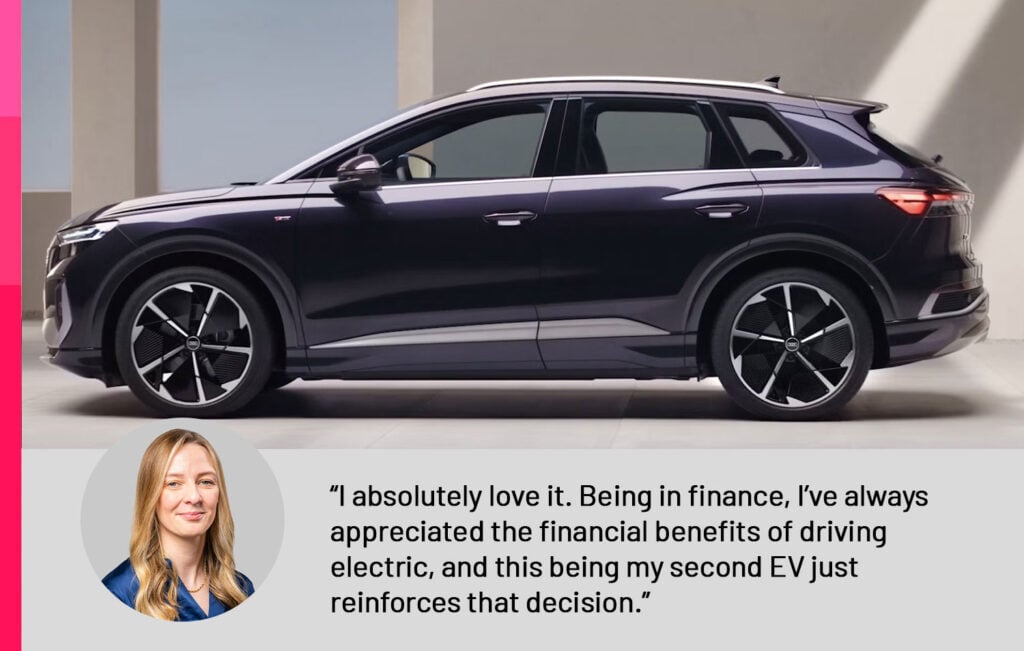
“The all-electric Audi Q4 e-tron has been fantastic – I genuinely love driving it,” says Zoe, Finance Manager at Fleet Alliance. “This is actually my second EV, and I was already aware of the financial and environmental benefits of switching. The Q4 e-tron really delivers on both value and performance.”
“Making the switch to electric has been completely hassle-free. Charging has been straightforward, with a Pod Point charge point installed at home, and the Q4 e-tron’s strong real-world range means I can enjoy cost-effective driving without any inconvenience. Not having to visit a petrol station is a real bonus, and it fits perfectly with both my lifestyle and sustainability goals.”
Grant Boardman case study
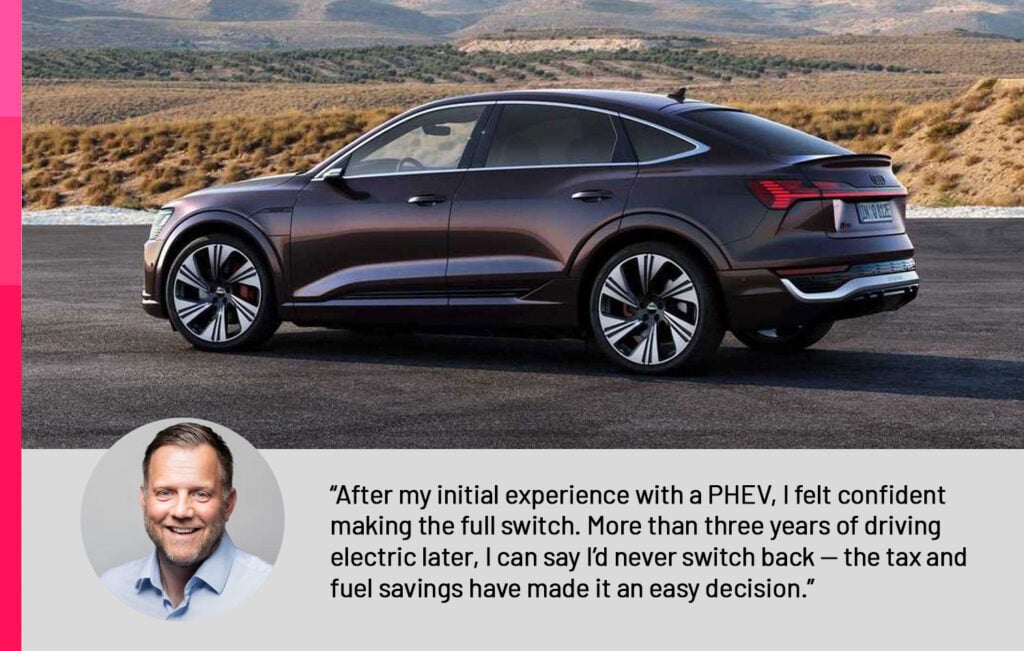
Grant Boardman, Client Services Director at Fleet Alliance, says he has fully embraced the company’s EV policy. “I’ve been a supporter of going electric for a while, especially with the financial and environmental benefits. I previously drove a Volvo XC60 PHEV, which helped with fuel costs and benefit-in-kind taxation, but I felt it was time to move to a full EV.”
“Charging technology has improved a lot since my first EV experience. Back in 2023, I tried using a domestic 3-pin plug, which was cumbersome and slow. Installing a dedicated home charger made the switch seamless, and now charging feels effortless.”
“Range anxiety isn’t what it used to be either. Even in colder Scottish weather, modern EVs like the Audi Q8 e-tron handle daily commuting easily. I can complete my weekly travel on a single charge, and the real-world efficiency is impressive.”
“Upgrading to the all-electric Audi Q8 e-tron has been fantastic. It’s powerful, comfortable, and cost-effective, while fully delivering on the environmental and financial benefits that first drew me to EVs. I couldn’t be happier with the switch.”