S h a r e
Choosing an EV – when you have your own driveway or garage

Posted by
The EV Team
January 2026
Are you thinking of switching to an electric car? If you have your own driveway or garage then you are in the ideal position to change easily into an electric vehicle (EV).
Many people argue that the barrier to choosing an EV is the charging infrastructure. But if you can charge overnight at home, you can start each day with a full charge and hundreds of miles available from your EV.
By installing a home wallbox, you can conveniently top-up, and keep EV running costs as low as possible when charging your car, with the option of using low-cost off-peak charging, as well.
Ordering a home smart charger
Although it is possible to charge an electric vehicle via a three-pin plug socket this is not advisable except in an emergency. The 13 amp domestic electricity circuit is not designed to take such loads continuously. It would also take a long time to charge your car’s battery.
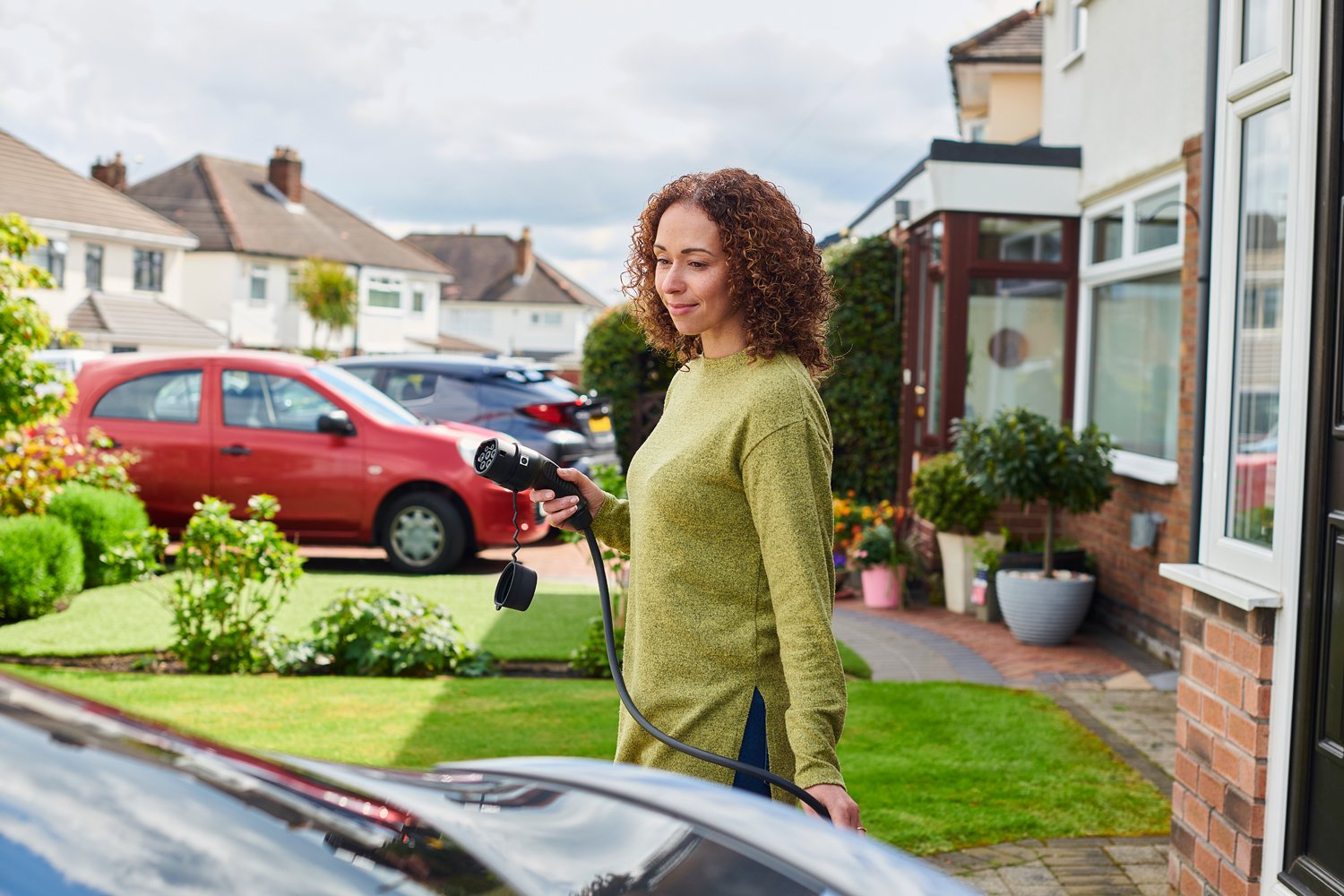
It is much more practical to use a home charger that can be fitted to an outside wall close to a driveway, or inside a garage.
What sort of home charger should I use?
There are four levels of domestic home charger:
3.6kW – this will charge 1.6x faster than a domestic three-pin socket
7kW – this will charge 3x faster than a domestic three-pin socket
11kW – this will charge 5x faster than a domestic three-pin socket
22kW – this will charge 10x faster than a domestic three-pin socket
It is easy to work out how quickly your battery will be charged simply by dividing the capacity of your battery by the output of your charger. So if, for example, we take the Renault 5 E-Tech with a 52kWh battery it would take the following length of time to be fully charged.
Approximate time to charge a Renault 5 E-Tech 52kWh on standard chargers:
3.6kW – 14 hours
7kW – 7 hours
11kW – 5 hours
22kW – 2.5 hours
Our recommendation would be a 7kW charger. This provides a quick enough charge to be able to have your car fully ready the next morning after an overnight charge, or you can quickly top up the battery if you need to. It’s also at a sweet spot of cost and charging speed.
If you wanted an 11kW or 22kW charger, your property would need a three-phase supply, which could be costly to upgrade to if it doesn’t have it already. Equally, some EVs can’t charge faster than 7kW or 11kW anyway (unless using the DC connection on a fast charger), so a more powerful point would not make any difference to charging times.
Should your wall charger be tethered or untethered?
When you are considering a home charger you will normally be offered the choice of a tethered charger or an untethered charger.
A tethered charge is where a cable is attached to the charger and you simply unwind it from its housing and plug it into your car’s connector.
An untethered charger comes with no cable – you just use the charging cable supplied with your car and plug it into the connector in your car and the charging connector.
Grants for a home charger
The Office for Zero Emission Vehicles (OZEV) previously offered a grant for installing a home charger. However, the grant is now only available to people living in rented properties or flats with dedicated off-street parking.
If you live in a rural or remote area of Scotland (including islands in Scotland), or you have received a used electric vehicle loan funded by Transport Scotland, you can apply for a £400 grant for a home charger.
Help with a home charger
Fleet Alliance has partnered with Scottish Power to form a new alliance called Fleet Zero. As part of that alliance, Scottish Power will be able to install both home chargers and workplace charging facilities for customers leasing their vehicles from Fleet Alliance. It’s just one way to make electrification simpler all round.
Changing electricity supplier
It is worth considering changing your electricity supply to make the most of off-peak energy tariffs depending on when you charge your car.
Home chargers usually come with an app that allows you to schedule your charging requirements to make the most of cheaper energy tariffs. You may also like to consider the benefits of switching to a green electricity supplier to match your new green car.
Most energy providers offer an EV-tailored tariff – both with off-peak charging times and a green energy promise – and comparison sites such as uSwitch will show what’s available.
Choosing the right EV
The range of electric vehicles on the market today is huge. It covers every sector, from city cars such as the Fiat 500e or MINI Cooper Electric to large SUVs such as the Kia EV9 – and just about everything in between.
If you’re looking for any car, there’s an EV for you. But you will need to work out exactly what you need from it to pick the right model.
Ask yourself what sort of trips you make on a regular, or even occasional basis? This will help determine how much range you really need rather than basing your requirement on the ‘what if we were to travel to [insert your own faraway choice of destination]’. EVs can cover that too, but it’s important to consider what you really need.
Just as important as car range is the ability of an EV to charge quickly – many of the latest cars with 800v architecture can charge up to 80% in under 20 minutes with a suitably high power charger. But if you don’t travel thousands of miles a month, a standard 400v architecture car is more affordable and perfectly suitable.
Most new electric cars today can travel almost 300 miles on a single charge, up from 235 in 2024; some can even cover more than 400 miles on a charge. To put this into perspective, the Department for Transport vehicle mileage data shows that the typical average daily mileage is only about 19 miles. At less than 95 miles a week, most EVs will only need a full charge every three weeks or so.
Although you may have an idea that you need an EV with a battery range of 300+ miles, properly analysing your driving needs could see you use a 200-mile EV with no compromise to your journey patterns.
But what if I need to go further than my range?
It’s simple enough to keep on the move for those occasional rare journeys that exceed your EV’s full range. But in these instances a little more planning is required than if you were driving a petrol or diesel car.
It’s also best to plan to stop when you have 20-25% charge left – it’s quicker to charge than if you run the battery right down and provides you with some battery back up in case there is a problem with your first choice of public charger (yes, it does sometimes happen). And talking of which, it is always best to have a plan B just in case your first choice of charging station is full, or unavailable for some reason.
You can use apps and websites such as Zap-Map that lists all of the public electric charge points in the UK. Most mapping services also feature a route planner so you can plot a trip via any required chargers. Many are now available with Apple CarPlay or Android Auto compatibility, so drivers can have them in-car as they drive.
Manufacturer-fitted navigation also has charge points stored within the system, and most of these are updated regularly via the car’s on-board SIM, so there’s less chance of the map being out of date.
For non-company car drivers, use salary sacrifice to access an EV
The benefits of electric cars are not just the preserve of company car drivers. Employees can access an electric car salary sacrifice scheme if offered by the company, which is far cheaper than leasing an EV personally, as well as preserving personal credit lines.
Electric car salary sacrifice essentially works by sacrificing some gross salary for an EV. There is some company car tax to pay – but this is minimal – and with the lower National Insurance and tax by the reduced gross salary makes it a highly tax-efficient way to access the low operating costs and zero tailpipe emissions of running an EV. If your employer does not operate an electric car salary sacrifice scheme, then ask them to consider it as a significant employee benefit.
If you have a driveway or garage, it could be an ideal way to switch to an electric car.
Electric cars are cheaper to run
Regardless of whether you are a company car driver or not, electric cars are cheaper to run. Overnight electricity rates are available from as low as 6p per kWh. Compare that to the average price of petrol (134.6p) or diesel (142.2p), as at August 2025, and significant savings can be made when comparing similar models.
It’s not just the hundreds of pounds saved in fuel costs that benefit EV drivers. Maintenance costs are significantly reduced too, because of how electric cars work. The electric motor has no tiny explosions taking place every second, as a combustion engine does. There is also less need for cooling of that motor, there is no gearbox to have to maintain, and far fewer moving parts in general.
Even consumables such as brakes will last longer, thanks to an EV’s brake energy recuperation system. This uses the motor to charge the battery, rather than draw from it, when slowing down. It is surprisingly effective and replaces the need to use the brakes so often in an EV.
Drive with care, and even tyres won’t cost much more, though with the instant torque available and heavier nature of EVs, tyre wear can be a little more than a petrol or diesel car, depending on your driving style. Regardless, most operators believe that an EV is at least 11% less costly to maintain than a traditional company car.
Finally, enjoy the EV driving experience!
Once your new electric lease car has been delivered you can start to enjoy the benefits of driving electric.
The key things you will notice is the silence at take-off and then just a slight humming sound when you are on the road. They are also very quick when you want them to be, while you will also notice the additional braking assistance provided by regenerative braking.
But otherwise, it is like driving a normal car – except with zero emissions. And no more filling up with fuel on a greasy forecourt – you can leave the charging to your wall charger overnight for additional convenience.
Check out what some of our employees had to say about driving electric when you have your own driveway or garage.
Kevin Blackmore – Case Study
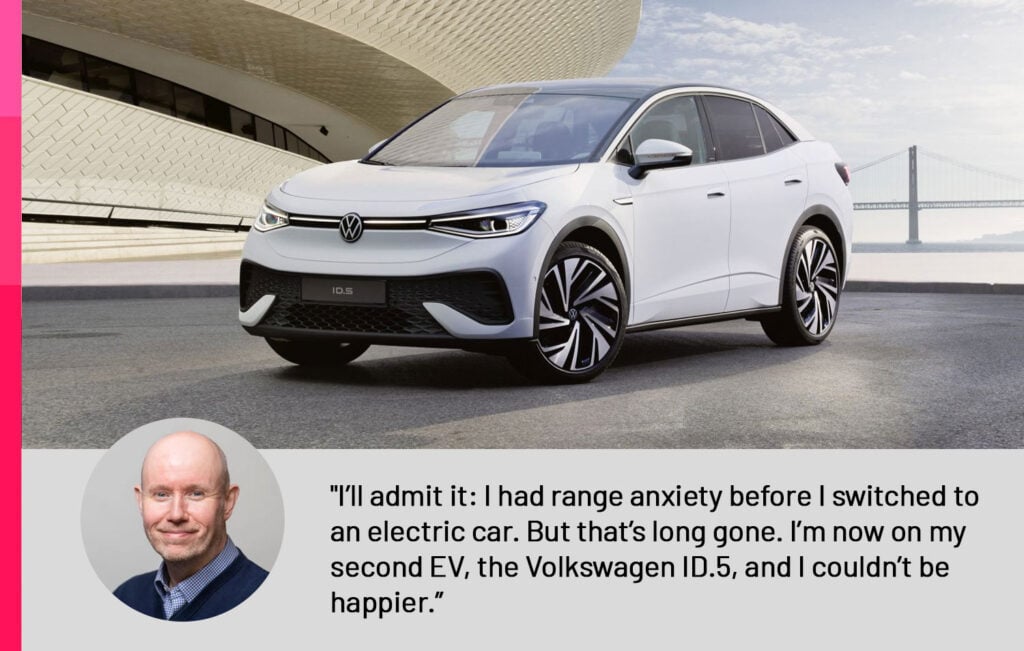
“I’ll admit it: I had range anxiety before I switched to an electric car. But that’s long gone. I’m now on my second EV, the Volkswagen ID.5, and I couldn’t be happier. Like many drivers, I rarely do long journeys, so one charge easily lasts me over a week and closer to two when I’m just commuting to work.
The best part is charging at home – with no more visits to greasy forecourts to fill up with fuel. With a charge point on my driveway, I simply plug in overnight and make use of the car’s downtime. And, thanks to my energy supplier’s low-cost EV tariff, those overnight charges cost only a fraction of what I used to spend on fuel.”
Jill Sidebottom – Case Study
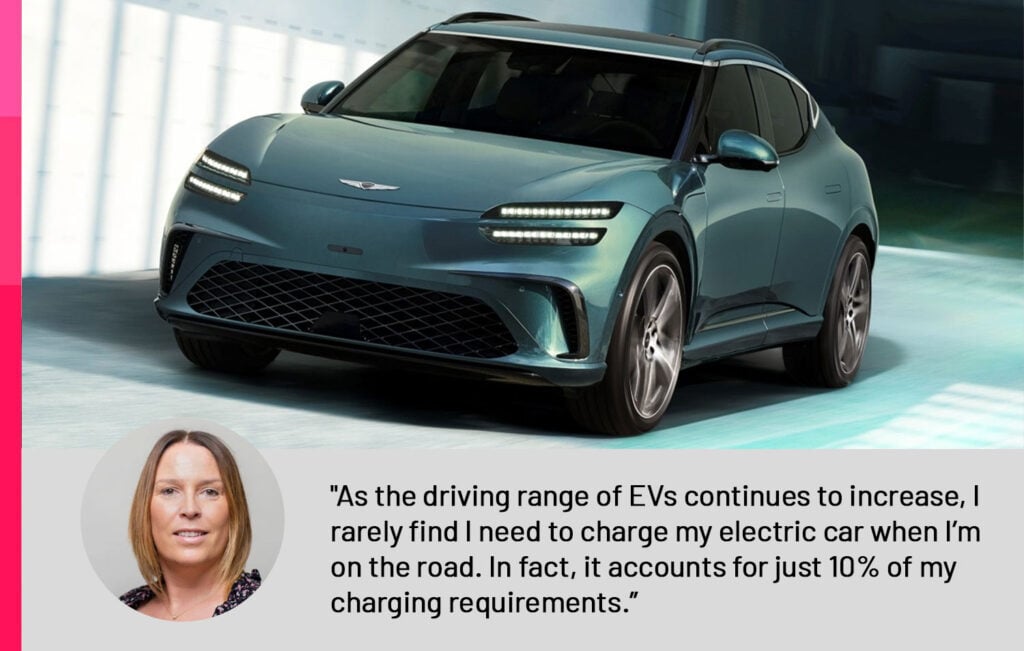
“As the driving range of EVs continues to increase, I rarely find I need to charge my electric car when I’m on the road. In fact, it accounts for just 10% of my charging requirements.
There’s no question that having your own driveway with a charger makes life with an EV so much easier. I get home in the evening, put my car on charge to use the cheaper overnight tariffs, and the next morning my car is fully charged and ready to go.
The transition from a combustion engine car to an EV was a mindset change for me. I suddenly realised it was simply like charging my mobile phone at night. But having access to the drive and my own charger, which I know is always free and working, makes life so much simpler.
At my current house I’ve chosen a tethered charger. In my previous house I decided to go untethered because I thought it made the charger look neater. But it’s a lot of hassle – opening the boot, getting your cable out, plugging it into the charger and the car…in the rain! No, it’s seriously not worth it! Tethered is definitely the way to go: simply grab the cable and plug in. Done.
While the public charging infrastructure is definitely getting better, nothing beats the convenience and cost effectiveness of having your own charger on your own driveway. We all lead busy lives, so keeping things simple is definitely a significant plus.”