S h a r e
The case for switching to electric power from a diesel van

Posted by
Charlie Strand
September 2026
Over a year ago, I heard a fleet manager at a conference describe switching a car fleet to electric as a “no-brainer”. His reasons were based on a range of factors: TCO, charging infrastructure and improving battery technology.
As we know, not everything that works for cars also works for light commercial vehicles (LCVs), with take-up for electric vans well below the level of the car market. That said, the latest data available from the SMMT for August 2026 tells a better story, with a record high for battery electric van mix with more than 16% of registrations. The increase has pushed the year-to-date uptake to 11.0%, up almost two percentage points on this time last year. So things are improving very gradually. But how easy is it to dump diesel and embrace electric if you’re running a van fleet?
Wide variety of electric vans now available
In terms of product, there is no shortage of choice. In most cases, whatever is available with a diesel engine is also available with electric power.
At the IAA Transportation Show in mid-September, Mercedes-Benz will launch a new model, based on a platform that will also be the basis for others – expect replacements for current Vito and Sprinter models.
We are also anticipating new models from several Chinese manufacturers including BYD, Chery’s Delivan brand, Farizon and Foton with its Cavan brand. Kia launched its PV5 van model earlier this year and IAA will be the launchpad for its PV7 range, expected to compete in the medium van segment against models such as the Ford Transit Custom.

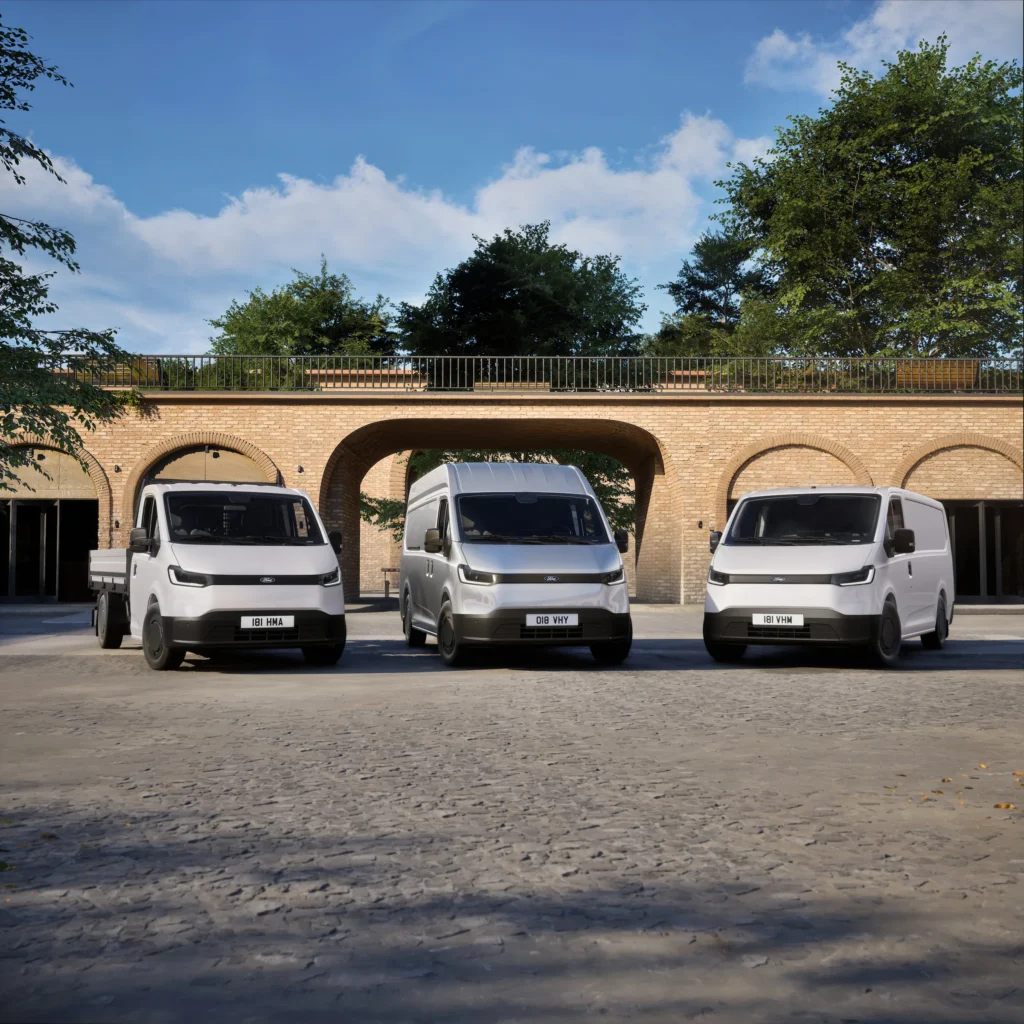
Talking of Ford, the Blue Oval is planning to launch the Ford Transit City later this year, a joint venture with Chinese manufacturer JMC. Starting at a sub £30k price (plus VAT), it will provide an attractive choice in the urban operating sector. It will be available in H1, H2 and chassis cab configurations, so should work across a variety of applications.
We are also seeing a revival of interest in car derived vans (CDV) with a raft of car manufacturers entering the market with electric models. These include BYD with a Dolphin CDV, as well as Dacia with a new Spring Cargo model, Skoda with its Enyaq Cargo and Volvo with the EX30 Cargo, while not forgetting Ford and its Explorer model, currently the van with the longest range.
The makers of these models are targeting users who work in and around Clean Air Zones (CAZ) such as the ULEZ in London and cities such as Bath, Birmingham, Bradford, Bristol, Sheffield and Tyneside which all charge non-compliant vans to enter their CAZ. There are also CAZs in Aberdeen, Dundee Edinburgh and Glasgow, although the rules are different from the CAZs in England, but still enforced with fines for non-compliant vehicles.
Driving range is still an issue for some van users, notably those on long-distance work and those involved in call-out work that need to be ready to go whenever and wherever they are wanted. Vehicles that run at or near maximum gross weight will inevitably have their driving range reduced, just as they do with diesel power.
This still leaves a large number of vans that do not cover large distances each day that could readily make the switch to electric power.
Recent research carried out for Chinese brand Farizon suggests that 71 per cent of trade van operators who responded to the survey would be prepared to make the switch to electric. Among the respondents aged 18-25, 85 per cent said they would consider switching to an electric van. There was less enthusiasm from older respondents to the survey with just 33 per cent of those over 65 saying they would consider a switch.
What about charging electric vans?
Charging is often seen as a barrier to wider electric vehicle adoption and that is certainly still an issue for van operators. According to Zapmap, which provides the UK Government with charging statistics, at the end of August 2026, there were 123,677 EV chargers, which are sited on 96,708 devices across 47,810 charging locations around the UK. Last month, there was a net increase of 953 EV chargers on the Zapmap platform.
That does not present the whole picture where LCVs are concerned though. Some public charging bays are not designed to accommodate longer LCVs which can limit charging options. The cost of installing depot charging can be large and prohibitive (although there are grants to help) in some places, it may take some years before a grid connection becomes available. Changing a business fleet to electric
Despite that, there may be other possibilities such as battery energy storage systems (BESS) which can use low-cost off-peak electricity and solar energy as a whole or partial solution. In these cases, a large battery pack, which can be portable so it can be used on different sites, can be connected to mains power and charged at low rates when electricity is cheapest. It could also take charge from solar panels on site. It could then be used to charge vehicles at the site. There are several providers of such systems.
Developments in battery composition and technology
Where vehicle batteries are concerned, a great deal has changed in the past 10 years. Chemistry has been continually improved to reduce charging times and increase range. Research is currently under way into batteries that can be fully re-charged in around six minutes, which really would be a game changer. New batteries using sodium in place of lithium are also under development, although these may be more suitable for stationary storage applications than in vehicles.
Driving range will be reduced in cold and poor weather and would need to be factored in. We suggest talking to one of our fleet specialists to work through the implications of reduced range on operational schedules to see what works best for you.
If electric LCVs are suitable for you, they can offer lower TCO, mainly because electric motors effectively have one moving part instead of hundreds in a combustion engine. They are easier to drive with a single speed gearbox and much quieter too. Drivers may prefer them. And, of course, the cost of diesel is currently hugely expensive, adding to the pressures on fleet budgets; electric is one way to reduce costs.
Electric vans may not yet suit every van fleet operation, but they can help to de-carbonise your operations, reduce costs, simplify maintenance and even put a smile on your drivers’ faces. So, with greater product now available, and improved ranges and carrying capabilities, now is definitely the time to consider a case for switching from a diesel van to electric.